Guides / Costs and buying
Loft boarding cost UK: DIY materials and fitted quotes
Build a dated UK loft boarding budget from deck area, raised supports, boards, insulation, access and labour scope.
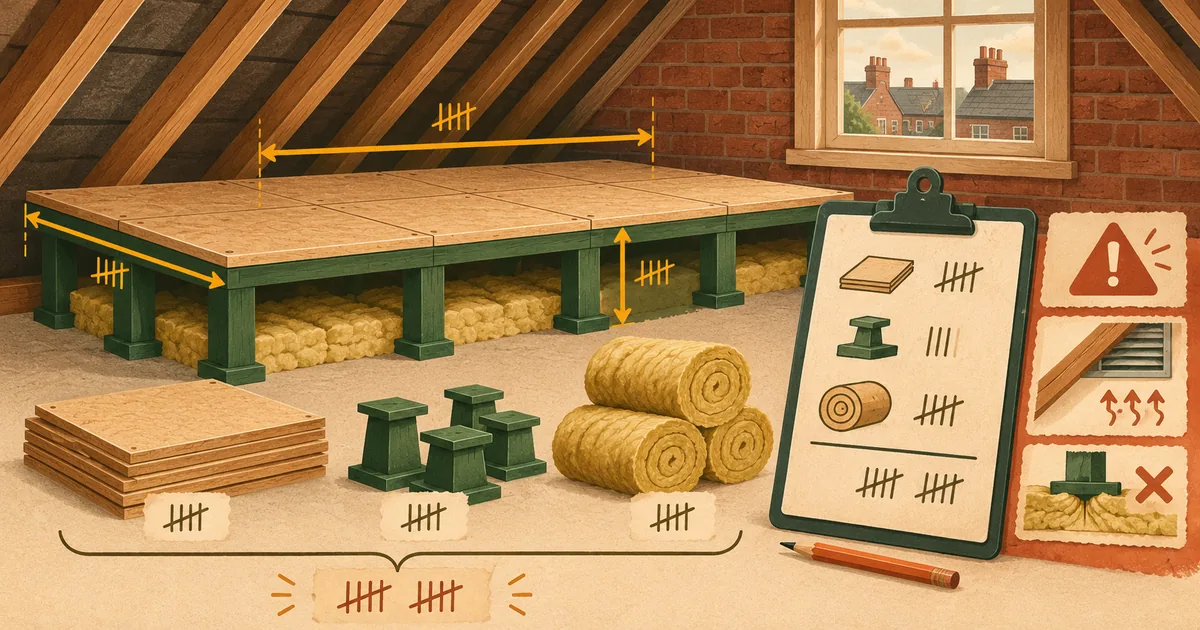
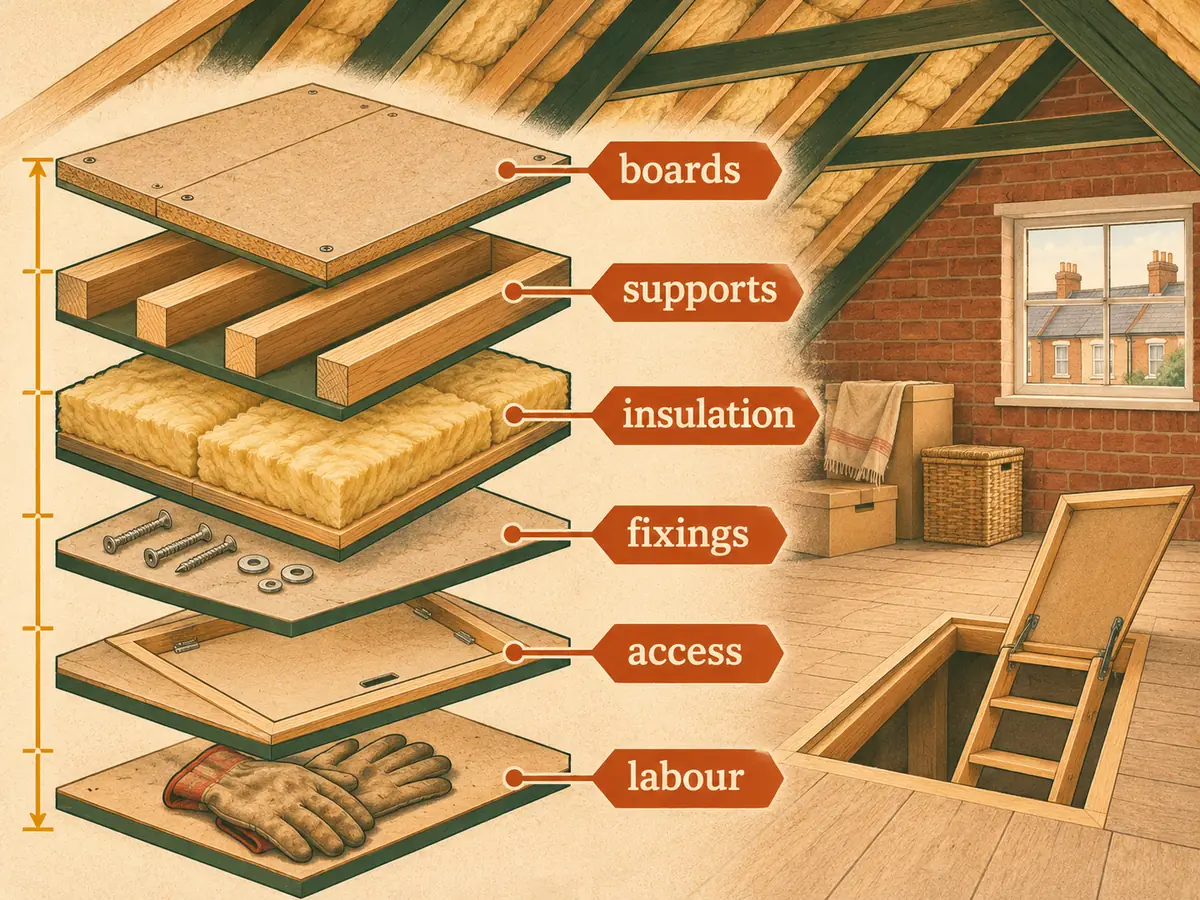
Loft boarding cost is driven by the area you actually deck, the height and type of raised support, board format, insulation top-up, access work and how awkward the roof is. A square-metre headline can hide hatch alterations, electrical work and structural investigation. Build a quantity schedule first, then compare quotes against the same scope.
Current DIY anchors
Wickes listed a pack of three 1220 × 320 × 18 mm non-structural loft panels at £16, covering 1.17 m², when opened on 15 November 2026. Its loft-leg category listed packs of twelve 175 mm legs at £18 and 300 mm XL legs at £20. Its insulation category listed 170 mm top-up rolls covering 6.47 m² and 200 mm rolls covering 5.61 m² at £27 each.
Those figures give a narrow materials baseline, not a complete job price. Stock, offers and delivery change. Check the product page and maker instructions when ordering. The small Wickes panel is listed as non-structural and not moisture resistant, so it should not be substituted for a specified P5 system without checking the whole design.
Worked 12 m² example
Suppose a rectangular deck is 4 m by 3 m. Adding 10% layout allowance gives 13.2 m². At 0.3904 m² per 1220 × 320 panel, the arithmetic gives 34 panels, or 12 three-packs because whole packs are required. At £16 per pack, boards are about £192.
Using the retailer's broad rule of four legs per small loft board gives 136 legs, or 12 packs. At £18 per pack, standard legs are about £216. The two headline components therefore total about £408 before screws, delivery, insulation, hatch edge, lighting, masks, goggles or waste beyond the chosen allowance.
If the same 12 m² requires a 170 mm top-up layer, 12 ÷ 6.47 rounds up to two rolls before any project-specific cutting allowance, about £54 at the opened listing. A sensible planning band for these three items is therefore about £460–£540, checked 15 November 2026: the lower end follows the simple counts, while the upper end allows another board or support pack and another roll. It is not a quotation.
What changes the DIY total
Deck shape. L-shapes and narrow strips produce more cuts and unusable offcuts than a rectangle. Buy whole packs and keep spare compatible boards for future access.
Support system. A rail-based kit has different components and layout rules from individual legs. Price the complete maker-designed grid, not just the visible supports.
Insulation depth. Measure existing mineral wool in several locations. Energy Saving Trust recommends at least 270 mm. If 100 mm remains between joists, a common top-up is 170 mm laid across them, but match the product and real construction.
Hatch and ladder. A new integrated hatch and folding ladder can cost substantially more than retaining a suitable hatch and fitting a basic sliding ladder. Structural trimming and making good are separate labour.
Lighting and electrical work. A battery light is a product purchase. A fixed light, new circuit or repairs to old wiring require a competent electrical scope and certification.
Condition. Damp, mould, timber damage, vermin, suspect asbestos or a bat roost stop the ordinary boarding job. Investigation and remedial work should not be hidden inside a square-metre allowance.
DIY versus fitted
DIY can reduce labour cost where access is easy, the structure is straightforward and the installer can follow the system manual. It also transfers measurement, material handling, safe access, cutting and responsibility to the householder. Loft panels are easier to pass through a small hatch than full sheets, but many more joints and supports must be planned.
A fitted quotation should state the deck area, support make and height, board type and thickness, insulation work, hatch and ladder work, lighting, waste removal and exclusions. Ask whether the quote preserves eaves ventilation, how services remain accessible and what happens if damaged joists are found.
Do not compare one quote for “10 m² boarding” with another for a raised system, insulation top-up and a hatch. Put both into a common table. The cheaper price may simply omit the work that protects thermal performance.
Professional insulation reference
Energy Saving Trust's current guide gives professional loft-insulation examples rather than boarding prices: around £750 for taking an uninsulated semi-detached loft to 270 mm and around £600 for topping 120 mm up to 270 mm. Those are national planning examples and may not include raised boarding. They help show why an insulation-and-deck quotation should separate the two scopes.
Use the calculator, then verify
The loft boarding calculator reproduces the current board, leg and roll defaults and rounds items up. Change the rectangle and construction details, then replace its default prices with your live delivered prices when comparing suppliers. The output is indicative only.
Keep a contingency for one additional pack, awkward edge details and safe access equipment. Do not use a financial contingency to cover an unknown structural problem; obtain advice and a defined repair scope instead.
Treat every quoted price as a snapshot. Recheck pack size, coverage, VAT, delivery and returns on the day of purchase, because a lower unit price can produce a higher delivered total after whole-pack rounding. Keep the calculator printout beside the order and note any substituted board or support. A substitution requires a fresh layout check; it is not merely an accounting change.