Guides / Access and lighting
Best loft lights UK: battery, bulb or wired fitting?
Compare battery pull lights, high-output LED bulbs and fixed LED fittings for UK loft access and storage.

We haven't tested these products. This comparison is based on makers' published specifications and manuals, retailer listings and owner reviews (checked 15 November 2026).
The best loft light makes the hatch, ladder, walkway and labels visible without adding a new hazard. A battery pull light is the simplest retrofit. A replacement LED bulb can make use of an existing sound fitting. New fixed wiring gives the most deliberate coverage but belongs with a competent electrician and Part P compliance.
Options at a glance
| Option | Published example | Strength | Limitation |
|---|---|---|---|
| Battery pull light | Loft Light, 320 lumens in the FAQ, three D batteries, 2 m cord | No mains wiring; position near access | Battery condition and modest output |
| Adjustable B22 LED | Loft Bulb, 4000 lumens, three adjustable panels | High output from an existing bayonet holder | Existing fitting must be suitable and safely placed |
| Fixed LED batten | Product-specific | Even walkway coverage and a wall switch | Electrical design, cable routes and installation |
| Portable work light | Product-specific | Temporary task lighting | Trailing lead, glare and unstable placement |
Battery pull light
Loft Leg's FAQ lists its Loft Light at 320 lumens, powered by three D batteries, with a 2 m pull string. The product page describes fixing the back to a timber element and says the unit is not for wet locations. The FAQ says it illuminates approximately 10 m²; treat that as the maker's estimate, not a guarantee in a dark, obstructed roof.
This format is useful beside the hatch because it can be switched before stepping away from the ladder. Position the pull where it cannot snag and where the fitting will not be struck by stored items. Check batteries periodically and keep a torch available: a battery light cannot be the only emergency plan.
High-output replacement bulb
The same maker lists a B22 adjustable LED Loft Bulb at 4000 lumens. Its three panels can be angled, and the published data says it is not dimmable. A replacement lamp is only appropriate if the existing holder, wiring and switching are sound and the lamp's size, weight, heat management and clearances fit the location.
Do not work live or assume an old loft circuit is safe because the lamp illuminates. Scorching, brittle cable, buzzing, repeated tripping or a damaged holder needs an electrician. Aim panels away from the ladder user's eyes and across the deck rather than directly at reflective foil.
Fixed LED batten
A fixed batten can spread light along a walkway with less glare than a single point source. Compare lumens, beam pattern, dimensions, temperature rating, ingress rating if the loft can be damp, and the maker's required mounting clearances. The installer should keep cables protected from boarding screws and future stored boxes.
Approved Document P covers electrical safety in dwellings. Electrical Safety First says a new circuit is work that must be undertaken or reviewed and signed off by a registered competent electrician. Even when work is not notifiable, it must still be safe and compliant. Ask the electrician what certificate will be provided.
Downlights below the loft
Boarding and top-up insulation can change the environment around ceiling downlights. Electrical Safety First says insulation or combustible material must not cover or contact a downlight unless the fitting is specifically designed and rated for that condition. It recommends a registered electrician for installation.
Do not solve this by creating random permanent holes in the insulation. Use a fitting or cover arrangement designed for the purpose and compatible with the exact downlight. Preserve the insulation continuity according to that system's instructions.
A practical lighting plan
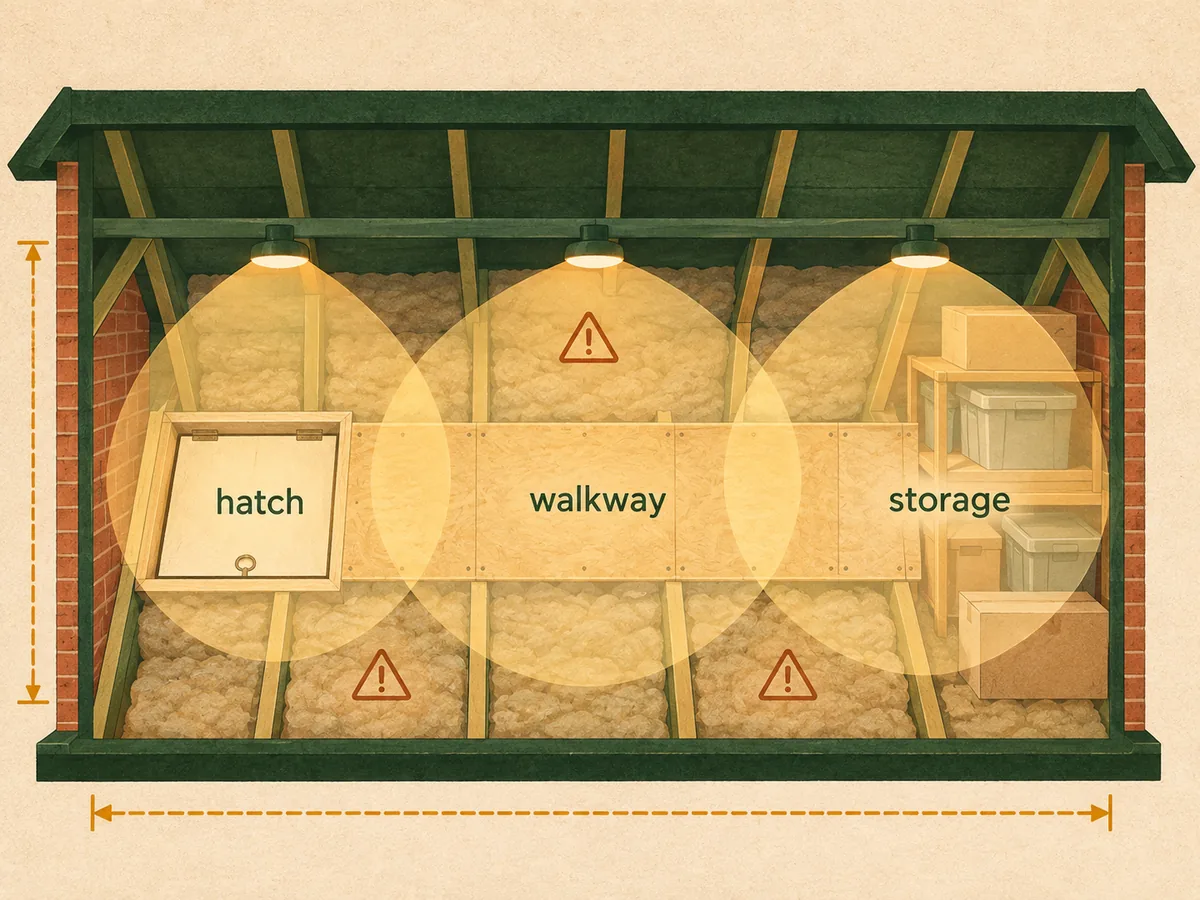
Start at the hatch. The first light should be reachable before climbing fully into the loft and should reveal the top of the ladder and deck edge. Add coverage along the route, then at storage labels or service points. Avoid deep shadows behind tanks and truss webs.
Light colour is secondary to usable distribution. Very high output from one small point can create harsh contrast, leaving corners darker when the eye adapts. Two lower-output fittings may give better coverage, but only if their installation is safe and the product instructions permit the position.
Controls should be obvious. A reflective pull is useful for battery units. A wall switch below or immediately inside the hatch can suit fixed lighting. Motion sensors avoid searching for a switch but can time out while someone is stationary; check that manual override and detection coverage suit the space.
Buying checklist
- Confirm whether there is safe existing mains lighting.
- Map the hatch, walkway and storage zone before choosing output.
- Read operating-temperature and moisture limitations.
- Keep fittings and cables away from boarding fixings.
- Plan battery inspection or electrical certification.
- Maintain clearances around downlights below the insulation.
For occasional access, a maker-specified battery pull light plus a torch is a low-complexity choice. For an existing sound B22 holder, a compatible LED can increase output without a new circuit. For regular access or a long deck, ask a registered electrician to design fixed coverage and protect cable routes before the boards go down.
Current retailer listings
Examples currently listed on Amazon UK include one 4 ft linkable LED batten, a two-pack of 4 ft linkable LED battens and a compact plug-in LED batten. These links are not a ranking and do not replace an electrical design. Check the exact listing, instructions, supply arrangement, mounting position and suitability for the loft environment; fixed wiring should be handled by a competent electrician.